
TRAINING MODERN ELECTRIC POWER SYSTEMS
Training Maintenance And Troubleshooting
Training Distribution System Modeling
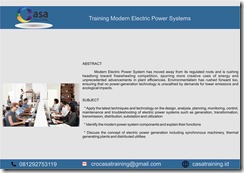
ABSTRACT training modern electric power systems terbaru
An electric power system is a network of electrical components deployed to supply, transfer, and use electric power. An example of a power system is the electrical grid that provides power to homes and industries within an extended area. The electrical grid can be broadly divided into the generators that supply the power, the transmission system that carries the power from the generating centers to the load centers, and the distribution system that feeds the power to nearby homes and industries. Modern Electric Power System has moved away from its regulated roots and is rushing headlong toward freewheeling competition, spurring more creative uses of energy and unprecedented advancements in plant efficiencies. Environmentalism has rushed forward too, ensuring that no power-generation technology is unscathed by demands for lower emissions and ecological impacts. Also over the past decade, computer capability has skyrocketed in effectiveness and plummeted in cost, launching a mass invasion of control rooms by digital instrumentation. Changes such as these make today’s power plant a more diverse and more complex mix of technologies than ever before. This course is designed to provide a good coverage of the generation, transformation, transmission, distribution and utilization of electric power and energy as well as the modeling, analysis, planning, design, monitoring and control of modern electric power systems. It will provide a contemporary overview of this far-reaching field as well as bringing together the core of knowledge from all of the many topics encompassed by the field. The course is intended to give participants a working knowledge of the modern electric power systems operations from generation through transmission and distribution through wiring. Basic electrical terminology and concepts are discussed with regard to design, construction, operations and maintenance of power plants substations and transmission and distribution lines. The effects of the deregulation of electric power utilities are discussed with interesting examples. The basic concepts of fiber optics and other telecommunications systems used in the electric power industry are also presented. Further, the course will introduce and explore a number of engineering and economic problems involved in planning, operating, and controlling power generation and transmission systems in electric utilities. The topics included serve as an effective means to introduce participants to advanced operations methods applied to practical electric power engineering problems. Some topics cover methods that are currently being applied in the control and operation of the modern electric power systems. However, in a 5-day course it is, of course, impossible to consider all the problems and “best practices” in this advanced field. We can only introduce the types of problems that arise, illustrate theoretical and practical approaches and point the participant the direction of seeking more information and developing advanced skills as they are required. As a matter of fact, this course covers a wide range of topics related to the design, operation and control of power systems that are usually treated separately. Various issues are treated in depth with analytical rigor and practical insight. The subject matter is presented in a very interesting and unique perspective. It combines, in a structured way, control theory, characteristics and modeling of individual elements and analysis of different aspects of modern electric power systems. Perlunya memilih provider training CASA TRAINING yang tepat agar pengetahuan kita mengenai MODERN ELECTRIC POWER SYSTEMS tidak salahTUJUAN TRAINING MODERN ELECTRIC POWER SYSTEMS
Dengan mengikuti pelatihan CASA TRAINING Peserta dapat berbagi pengetahuan / sharing knowledge mengenai MODERN ELECTRIC POWER SYSTEMS dengan peserta dari perusahaan lain yang bergerak di bidang MODERN ELECTRIC POWER SYSTEMS
MATERI
- Apply the latest techniques and technology on the design, analysis, planning, monitoring, control, maintenance and troubleshooting of electric power systems such as generation, transformation, transmission, distribution, substation and utilization
- Identify the modern power system components and explain their functions
- Discuss the concept of electric power generation including synchronous machinery, thermal generating plants and distributed utilities
- Explain the theory & principles of transformers and identify its various types as well as their features & functions
- Determine the transmission system structure, components & accessories and sag & tension of conductor
- Identify the different types of substations such as substation grounding, lightning & substation fire protection
- Employ the distribution system modeling & analysis and power system operation & control
- Describe electric power utilization including the metering of electric power & energy and load characterization & load modeling
- Employ the methodological process of power system analysis & simulation and identify fault analysis in power systems
- Discuss the principles of power system protection & power system transients including the protection of synchronous generators, digital relaying, lightning strokes, over voltages, switching surges & insulation coordination
- Implement the power system dynamics & stability with its methodological applications used in modern power system
- Carryout power system planning & reliability applied in power systems
- Discuss the power electronics & power quality and recognize their practical use in modern electric power system
- Use economic dispatch of thermal units including its methods of solution
- Identify the factors affecting power system security and determine the variables to be considered in the environmental controls of electric power system
METODE TRAINING MODERN ELECTRIC POWER SYSTEMS
Metode penyelenggaraan baik secara training online atau training zoom atau training daring maupun training offline atau training tatap muka :
- Presentasi
- Diskusi antar peserta
- Studi kasus
- Simulasi
- Evaluasi
- Konsultasi dengan instruktur
TRAINER/ INSTRUKTUR
Instruktur yang berkompeten di bidang MODERN ELECTRIC POWER SYSTEMS
Tim Instruktur CASA TRAINING
Kegiatan training dan konsultansi dikelola oleh para tenaga ahli dan instruktur yang berpengalaman dan berkompeten di bidangnya. Ini akan menjadi “kunci” bagi suksesnya aktivitas training dan konsultansi yang dijalankan.Juga menjadi kunci bagi perkembangan perusahaan anda di masa depan.
Karena kompleksnya pelatihan ini, maka dibutuhkan pendalaman yang lebih komprehensif melalui sebuah training.Dan menjadi sebuah kebutuhan akan training provider yang berpengalaman di bidangnya agar tidak membuat peserta menjadi cepat bosan dan jenuh dalam mendalami bidang teknik ini.
Jadwal Pelatihan Casa Training 2026 :
Batch 1 : 20 – 21 Januari 2026 Batch 2 : 10 – 11 Februari 2026 Batch 3 : 3 – 4 Maret 2026 Batch 4 : 14 – 15 April 2026 Batch 5 : 19 – 20 Mei 2026 Batch 6 : 24 – 25 Juni 2026 Batch 7 : 8 – 9 Juli 2026 Batch 8 : 19 – 20 Agustus 2026 Batch 9 : 16 – 17 September 2026 Batch 10 : 7 – 8 Oktober 2026 Batch 11 : 18 – 19 November 2026 Batch 12 : 9 – 10 Desember 2026Lokasi Training Offline atau Online :
- Yogyakarta
- Jakarta
- Bandung
- Bali
- Surabaya
- Lombok
- Online via Zoom Catatan : Apabila perusahaan membutuhkan paket in house training, anggaran investasi pelatihan dapat menyesuaikan dengan anggaran perusahaan.