
TRAINING GAS TURBINE
Training Operation, Maintenance, And Trouble
Training Turbine Technology
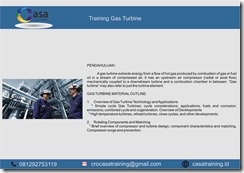
PENDAHULUAN : TRAINING GAS TURBINE
Gas–turbine engine adalah suatu alat yang memanfaatkan gas sebagai fluida untuk memutar turbin dengan pembakaran internal. Di dalam turbin gas energi kinetik dikonversikan menjadi energi mekanik melalui udara bertekanan yang memutar roda turbin sehingga menghasilkan daya. A gas turbine extracts energy from a flow of hot gas produced by combustion of gas or fuel oil in a stream of compressed air. It has an upstream air compressor (radial or axial flow) mechanically coupled to a downstream turbine and a combustion chamber in between. “Gas turbine” may also refer to just the turbine element. Energy is released when compressed air is mixed with fuel and ignited in the combustor. The resulting gases are directed over the turbine’s blades, spinning the turbine, and mechanically powering the compressor. Finally, the gases are passed through a nozzle, generating additional thrust by accelerating the hot exhaust gases by expansion back to atmospheric pressure. Energy is extracted in the form of shaft power, compressed air and thrust, in any combination, and used to power aircraft, trains, ships, electrical generators, and even tanks. To support the sufficient production system, we need tough worker or increase the worker skill of operation, maintenance, and trouble shooting of gas turbine profession. Perlunya memilih provider training CASA TRAINING yang tepat agar pengetahuan kita mengenai GAS TURBINE tidak salahPARTICIPANTS TRAINING GAS TURBINE
Practitioner in the operator level, supervisor level or planner of machine maintenance technology at engineering industry, which at least senior high school or technical vocational school.OBJECTIVE TRAINING : training operation, maintenance, and trouble terbaru
- To able know to operation, maintenance, and trouble shooting of gas turbine.
OUTLINE: TRAINING GAS TURBINE
- Overview of Gas Turbine Technology and Applications
- Simple cycle Gas Turbines; cycle considerations; applications; fuels and corrosion; emissions; combined cycle and cogeneration. Overview of Developments
- High temperature turbines, reheat turbines, close cycles, and other developments.
- Rotating Components and Matching
- Brief overview of compressor and turbine design; component characteristics and matching. Compressor surge and prevention.
- Vibration and Rotor Dynamics
- A review of vibration will include specific problems such as Blade Vibration and Shaft Critical Speeds. Case histories will link vibration with the fatigue failure of components. Rotor instability, in its various forms, will be discussed. Vibration spectrum analysis will be utilised for the solution of resonance, instability, and gear and blade problems. Campbell (Spoke) diagrams and Critical Speed maps will be derived and used for the solution of vibration and Rotor Dynamic problems. The design and performance of Squeeze-Film Damper Bearings for overcoming many of the problems associated with machine unbalance and critical speeds, will be covered.
- Combustors and Fuels
- A description of combustor types, chamber design, fuel atomisation, ignition and combustor arrangements will be presented. Also discussed will be the constraints imposed by fuels on the design and operation of the hardware. The wide spectrum of fuels, both gaseous and liquid, is examined. An overview of fuel treatment and additives will be made.
- Performance Analysis
- Basic thermodynamic aspects of stationary Gas Turbines. Design and off-design operation. Influence of site effects on typical performance maps. Variable geometry compressor and turbine status.
- Performance Analysis for Problem Detection
- The fundamental concepts of performance analysis as a tool for saving energy costs are discussed. Basic and applied thermodynamics will be reviewed for gas turbines. The use of performance data to pinpoint problem areas will be discussed. Diagnostics related to fouling, nozzle erosion, bowing surge, choke, etc. will be covered. Meaningful trending methods will also be discussed.
- Gas Path Analysis for Stationary Gas Turbines – Status
- Simulation of degraded Gas Turbines, derivation and application of fault coefficient matrix, fault trees and other techniques. Implications for component life and emissions.
- Gas Turbine Fouling
- The causes, effects and detection of fouling in axial compressors will be covered including aero thermodynamic effects, effects on surge margin, intake distortion and blading problems. Filtration and control techniques will be covered.
- Gas Turbine Repair
- The techniques of inspection and repair of gas turbines are described in detail, including NDT techniques, cleaning, plating, heat treatment, welding, etc.
- Maintenance
- Case histories of various types of failures and maintenance problems of onshore and offshore gas turbine compressor installations are discussed. Maintenance techniques using bore scope and spectrum analysis including acoustic monitoring are discussed. Techniques for checking and conducting repairs on impellers, diffusers, bearings, couplings, and foundation repair are emphasised.
- Special Considerations for CHP Gas Turbines
- This section will cover special considerations in design, operation and maintenance of turbines and associated equipment on Cogeneration Services. Several cases will be covered. Off design operation effects on HRSG, STTG Cycles and evaporate cooling will be covered.
METODE
Metode penyelenggaraan baik secara training online atau training zoom atau training daring maupun training offline atau training tatap muka :
- Presentasi
- Diskusi antar peserta
- Studi kasus
- Simulasi
- Evaluasi
- Konsultasi dengan instruktur
TRAINER/ INSTRUKTUR
Instruktur yang berkompeten di bidang GAS TURBINE
Tim Instruktur CASA TRAINING
Kegiatan training dan konsultansi dikelola oleh para tenaga ahli dan instruktur yang berpengalaman dan berkompeten di bidangnya. Ini akan menjadi “kunci” bagi suksesnya aktivitas training dan konsultansi yang dijalankan.Juga menjadi kunci bagi perkembangan perusahaan anda di masa depan.
Karena kompleksnya pelatihan ini, maka dibutuhkan pendalaman yang lebih komprehensif melalui sebuah training.Dan menjadi sebuah kebutuhan akan training provider yang berpengalaman di bidangnya agar tidak membuat peserta menjadi cepat bosan dan jenuh dalam mendalami bidang teknik ini.
Jadwal Pelatihan Casa Training 2026 :
Batch 1 : 20 – 21 Januari 2026 Batch 2 : 10 – 11 Februari 2026 Batch 3 : 3 – 4 Maret 2026 Batch 4 : 14 – 15 April 2026 Batch 5 : 19 – 20 Mei 2026 Batch 6 : 24 – 25 Juni 2026 Batch 7 : 8 – 9 Juli 2026 Batch 8 : 19 – 20 Agustus 2026 Batch 9 : 16 – 17 September 2026 Batch 10 : 7 – 8 Oktober 2026 Batch 11 : 18 – 19 November 2026 Batch 12 : 9 – 10 Desember 2026Lokasi Training Offline atau Online :
- Yogyakarta
- Jakarta
- Bandung
- Bali
- Surabaya
- Lombok
- Online via Zoom Catatan : Apabila perusahaan membutuhkan paket in house training, anggaran investasi pelatihan dapat menyesuaikan dengan anggaran perusahaan.