
TRAINING CREATING PLANNING STRATEGIES
TRAINING CREATING PLANNING STRATEGIES
Time Management Styles
Creating planning strategies
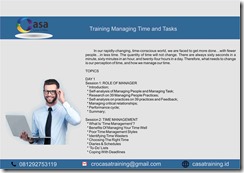
MATERI TRAINING CREATING PLANNING STRATEGIES
Perencanaan strategis (strategic planning) adalah “proses pemilihan tujuan–tujuan organisasi; penentuan strategi, kebijaksanaan dan program-program strategik yang diperlukan untuk tujuan–tujuan tersebut; dan penetapan metoda-metoda yang diperlukan untuk menjaga bahwa strategi dan kebijaksanaan telah diimplementasikan”.
In our rapidly-changing, time-conscious world, we are faced to get more done…with fewer people…in less time. The quantity of time will not change. There are always sixty seconds in a minute, sixty minutes in an hour, and twenty-four hours in a day. Therefore, what needs to change is our perception of time, and how we manage our time.
By organising your workload effectively rather than constantly reacting to events you can become more efficient and regain control of that most valuable resource… time.
Employers are constantly requiring their managers to take on more and more work. By becoming better organised in your working day, you can achieve greater efficiency, or leave for home on time without feeling guilty. The potential to achieve more in your job and career is partly dependent upon how well your time is managed. This is a highly participative programme in which delegates will be given a series of individual exercises and guidance in improving their use of time and managing their tasks
Perlunya memilih provider training CASA TRAINING yang tepat agar pengetahuan kita mengenai CREATING PLANNING STRATEGIES tidak salah.
TUJUAN TRAINING
- To enable participants to clearly identify their roles and responsibilities;
- To enable understanding work-related and personal time wasters, and generate ways to overcome them
- To enable participants to understand their key priorities and SMART goals in their work
- To introduce participants practical tools to use at work and ensure they make time to focus on priority tasks
- To assist participants to develop a more proactive approach at work
- To learn the important rules of Time Management
- To practice effective coaching to their subordinates;
- To delegate effectively;
- To monitor and to evaluate subordinates tasks;
- To motivate subordinates in performing high standard;
- To manage job-stress effectively.
What You Will Gain
- The ability to gain a substantial increase in performance
- A greater awareness of the importance of time and task management in achieving business targets
- A clear understanding of your personal and work-related time wasters
- An awareness of the importance of prioritising in your day-to-day work
- Each participant will take away a SMART goal and action plans, to improve their Time Management and personal effectiveness, which they can put into effect immediately after the course
Who Should Attend?
* Managers, supervisors, senior staffs
TOPICS AND SCHEDULE training creating planning strategies murah
DAY 1
- Session 1: ROLE OF MANAGER
- Introduction;
- Self-analysis of Managing People and Managing Task;
- Research on 39 Managing People Practices;
- Self-analysis on practices on 39 practices and Feedback;
- Managing critical relationships;
- Performance cycle;
- Summary;
- Session 2: TIME MANAGEMENT
- What Is ‘Time Management’?
- Benefits Of Managing Your Time Well
- Poor Time Management Styles
- Identifying Time Wasters
- Choosing The Right Time
- Diaries & Schedules
- ‘To-Do’ Lists
- Coping With Deadlines
- Personal Review
- Time Logs
- Setting Limits
- Session 3: Group Exercise and Presentation: Time Management Assessment
- Group Discussion;
- Group Presentation
- Class Discussion and Insight
- Session 4: MANAGING PRIORITIES AND MULTI-TASK
- Introduction to managing priorities
- Prioritising through goals and objectives
- Dealing with changes
- Creating planning strategies
- Project planning
DAY 2
- Session 1: DEVELOPING SMART GOAL AND ACTION PLANS
- Introduction – Performance Cycle;
- Organization’s corporate goals;
- The need to communicate corporate goals at all levels;
- Importance of goal setting;
- How goals are se;
- Criteria of goals;
- Components of goal statements;
- Action verbs – measurable;
- Gaining Commitment on Goal Setting;
- Gaining Commitment Exercise;
- Goal setting Practices of Outstanding Managers; Summary
- Session 2: Group Exercise and Presentation: DEVELOPING SMART GOAL AND ACTION PLANS
- Group Discussion;
- Group Presentation
- Class Discussion and Insight
- Session 3: EFFECTIVE COACHING TECHNIQUES
- Introduction to coaching;
- Coaching – What is coaching /counseling;
- How to determine if coaching is needed;
- Coaching model;
- Feedback exercise;
- performance feedback tips;
- Steps for conducting formal observation;
- Review of implementation of the models;
- Corrective action;
- Coaching practices of outstanding managers;
- Summary
- Session 4: Role-Play: EFFECTIVE COACHING TECHNIQUES
- Individual Role-play;
- Group Presentation
- Class Discussion and Insight
DAY 3
- Session 1: EFFECTIVE DELEGATION
- Why Delegate?
- What Is Delegation?
- Who Is the Right Person for the Task?
- How Can You Avoid Mistakes in Delegation?
- How to give better instructions?
- What Communication Skills Help Get Results?
- How Can Delegation Be Monitored?
- Session 2: MONITORING & EVALUATION TECHNIQUE
- Introduction to monitoring and evaluation terms and concepts
- Difference between monitoring and evaluation
- Monitoring techniques
- Advantages and disadvantages of various monitoring techniques
- Objectively verifiable indicators
- Means of verification
- Deciding which reporting methods to use
- Collecting, analyzing and storing information
- Communication M&E findings for action and accountability
- Evaluation techniques
- Session 3: MOTIVATING AND REWARDING
- Understanding People
- Why people work and what are their key motivators?
What are the motivating factors?
What employees want from their bosses and their jobs?
What are the causes of de-motivation?
Working with others to talk them out of de-motivation and into getting things off their chest
Planning what to do next- Concepts and Theories of Motivation
- Understanding the theories and putting them into practice (e.g. Maslow, Hertzberg and McGregor)
* Working with De-motivated Individuals - Providing support and recognition
Empathising and understanding the issue
Involvement through empowerment
Providing a sense of ownership and responsibility- Personal Development
- Preparing and developing a personal action plan to support your return to the workplace
- Introduction to Rewarding;
- Informal and Formal Rewards;
- Giving Informal Rewards;
- Rewarding practices of outstanding managers;
- Summary
- Session 4: STRESS MANAGEMENT
- What is stress
- How to take advantage of stress to increase your performance
- What is the impact of stress at individual or organisational level
- How to monitor yourself to detect the early signs of stress
- What are the myths about stress
- How to interact with people and manage your stress to get maximum results
- How to use the power of mind to its fullest capacity to get back in control of your life
- How to organise and use time management to increase performance and reduce stress
- How to read body language signals
- How to assertively communicate with others
- What physical exercises work best to relive stress
- How to observe your emotions when getting stressed and respond to them accordingly
- How to say No and offload work from your busy life
- How to use the power of positive thinking to master the art of stress management
METODE
- Presentasi
- Diskusi antar peserta
- Studi kasus
- Simulasi
- Evaluasi
- Konsultasi dengan instruktur
TRAINER/ INSTRUKTUR
Jadwal Pelatihan Casa Training 2026 :
Batch 1 : 20 – 21 Januari 2026
Batch 2 : 10 – 11 Februari 2026
Batch 3 : 3 – 4 Maret 2026
Batch 4 : 14 – 15 April 2026
Batch 5 : 19 – 20 Mei 2026
Batch 6 : 24 – 25 Juni 2026
Batch 7 : 8 – 9 Juli 2026
Batch 8 : 19 – 20 Agustus 2026
Batch 9 : 16 – 17 September 2026
Batch 10 : 7 – 8 Oktober 2026
Batch 11 : 18 – 19 November 2026
Batch 12 : 9 – 10 Desember 2026
Lokasi Training Offline atau Online :
- Yogyakarta
- Jakarta
- Bandung
- Bali
- Surabaya
- Lombok
- Online via Zoom
Catatan : Apabila perusahaan membutuhkan paket in house training, anggaran investasi pelatihan dapat menyesuaikan dengan anggaran perusahaan.
Fasilitas Training Offline atau Online :
Negotiable / by request